Case Study · Thai Massage & Wellness · Scroll Film · Booking Flow · Demo Project
LADDAWAN
A demo website for massage studios
with a scroll film and account-free booking
A complete website for a Thai massage studio: a scroll-driven film walks you through the house in five steps, nine treatments are listed with their prices in full, and the booking flow reaches an appointment in four steps — with no account and no registration.
Note: LADDAWAN is a concept showcase by BTECH SOLUTIONS. The studio does not exist; the brand, the prices and the treatments were designed for this demo, and the film's imagery is AI-generated — no real people are shown and no face appears in any frame. The booking flow can be walked end to end but creates no appointment. The measurements quoted here come from Lighthouse desktop runs against the live demo.
Technical quality (desktop test)
Lighthouse · Desktop · measured on 2026-07-30 · massage-studio.thaikickstarter.eu
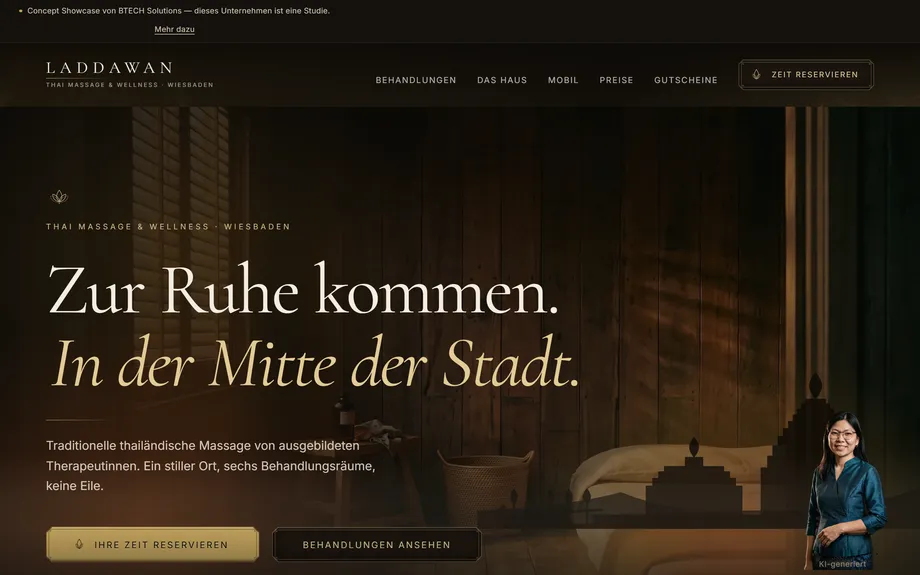
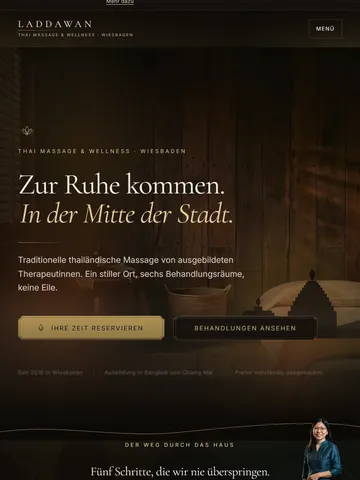
The page as a whole
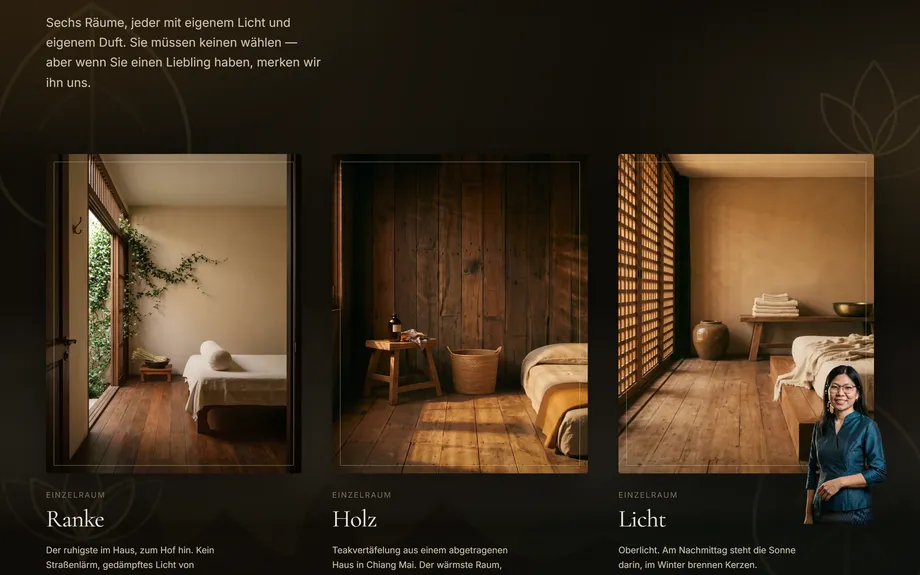
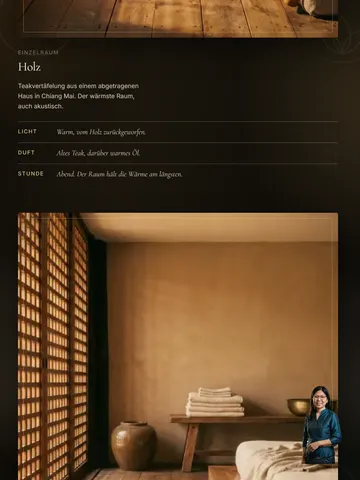
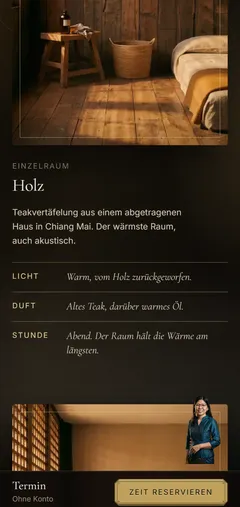
The same page at three screen widths. Scroll — it moves along in all three.
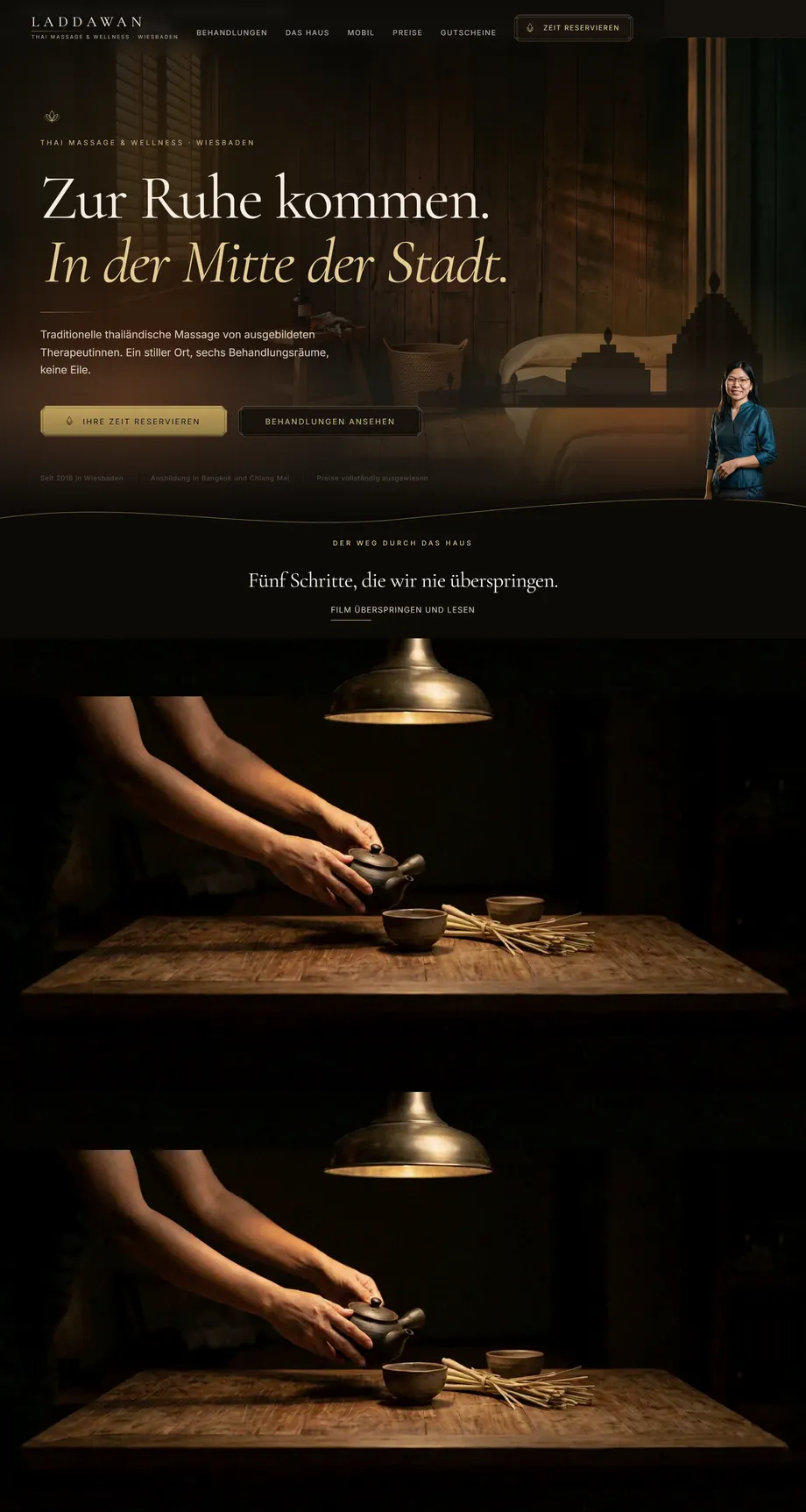
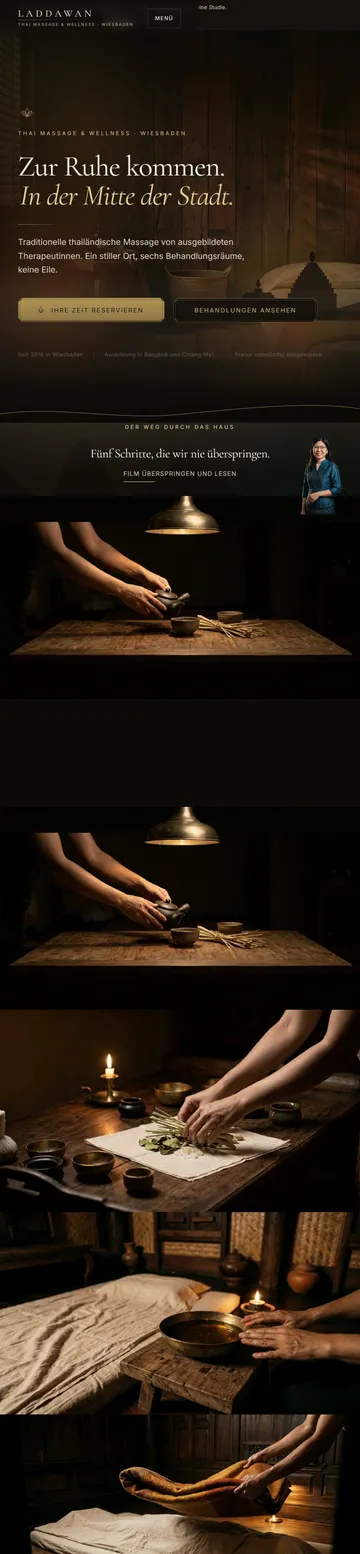

Project overview
LADDAWAN is a Thai massage and wellness studio in Wiesbaden — six treatment rooms, trained therapists, and a stance that carries the business: "We do not sell treatments. We give time back." The studio does not exist; it was designed as a concept showcase, and it says so in a band above the header on every page.
The occasion is a concrete one. Massage studios are usually found through portals that take a commission, own the customer relationship and turn the offer into a price comparison. This demo shows the counter-proposal — a site of one's own, where the treatment is explained, the price is stated and the appointment is made directly.
The site is therefore not built around the studio but around the guest's decision: which treatment suits how I feel, what it costs, how long it takes — and when I can have it.
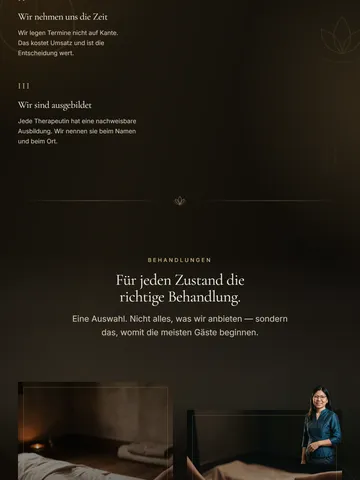
- Nine treatments, each with its own page, duration tiers and price
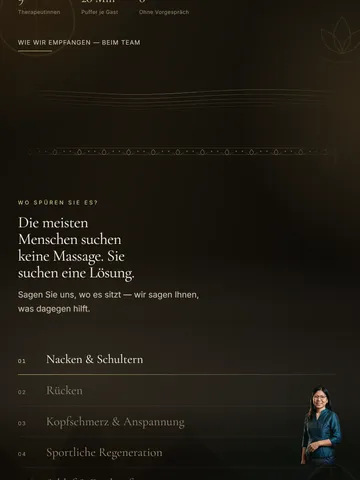
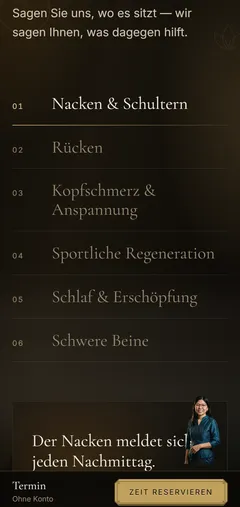
- Treatments sorted by how you feel, not by catalogue logic
- Vouchers as an area of their own, including a purchase flow
- The study declaration sits above the header, not in the small print
- A site of one's own instead of a portal profile — no commission, no comparison list
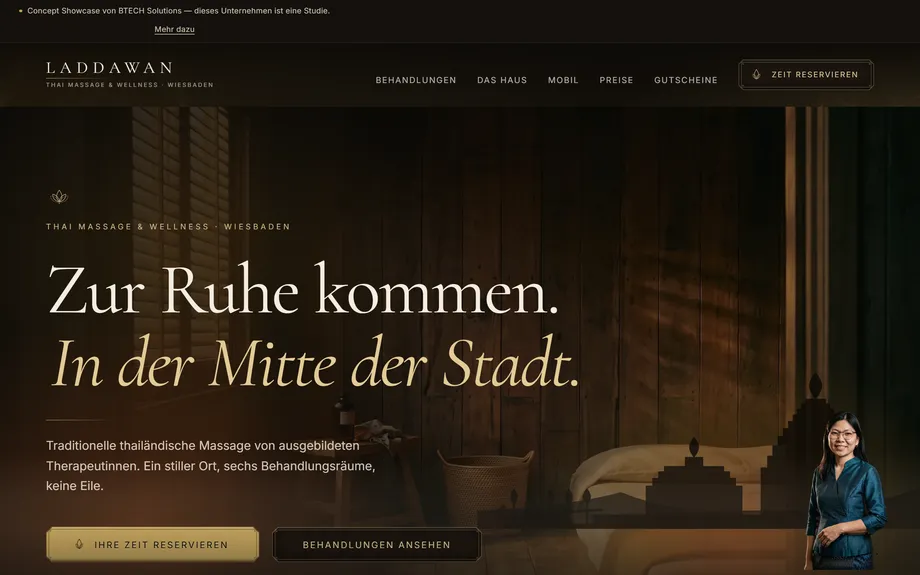
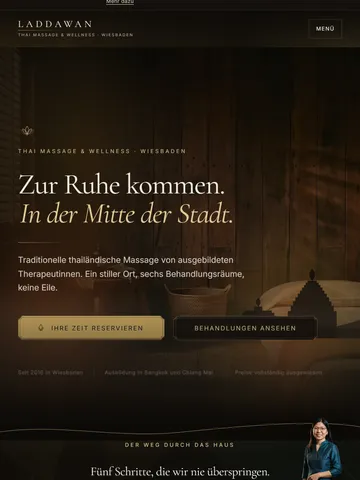
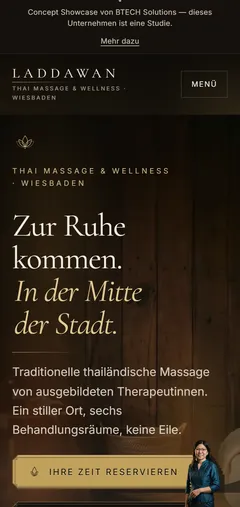
The way through the house
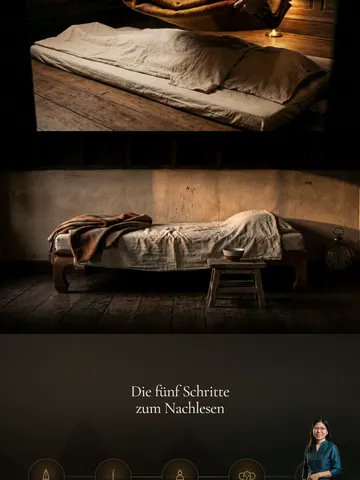
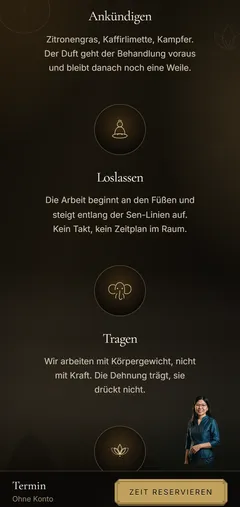
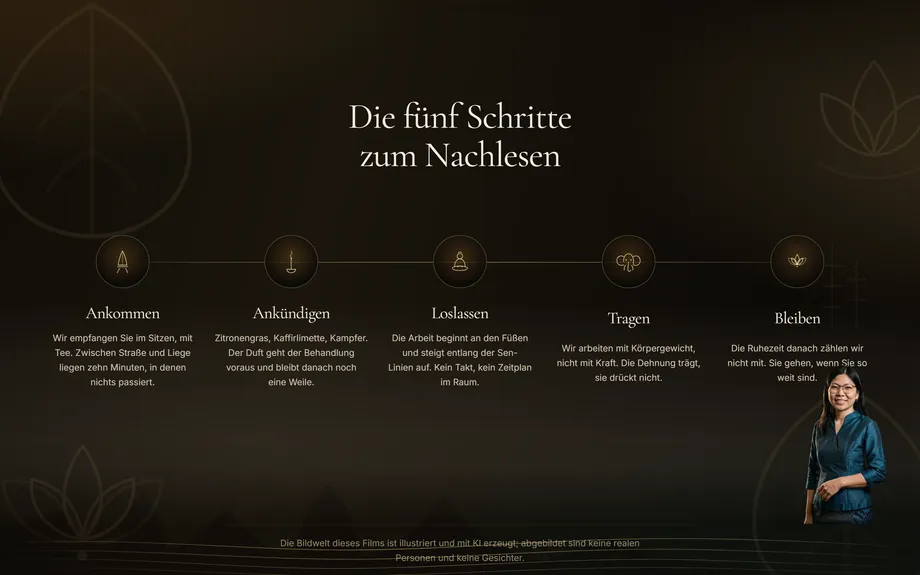
Instead of an image carousel, the home page carries a scroll-driven film: "Five steps we never skip" — arriving, announcing, letting go, carrying, staying. It explains not the service but the experience, and so answers the question that precedes every first booking: what is actually going to happen to me?
The motion is tied to scroll position rather than to a running time. Read more slowly and the scene runs more slowly. Right beside the film sits "Skip the film and read it" — and below that the same five steps as text, in the same sentences. Anyone who will not or cannot scroll loses nothing.
That the imagery is illustrated and AI-generated is stated at the film itself, not in the imprint. No real people are depicted and no face appears in any frame — in a trade where image rights covering therapists and guests are delicate, that is a deliberate decision.
- Five chapters: arriving, announcing, letting go, carrying, staying
- Tied to scroll position rather than to a running time
- A full text version right beside it, in the same sentences
- The origin of the images declared at the film, not in the imprint
- No real people, and no face in any frame
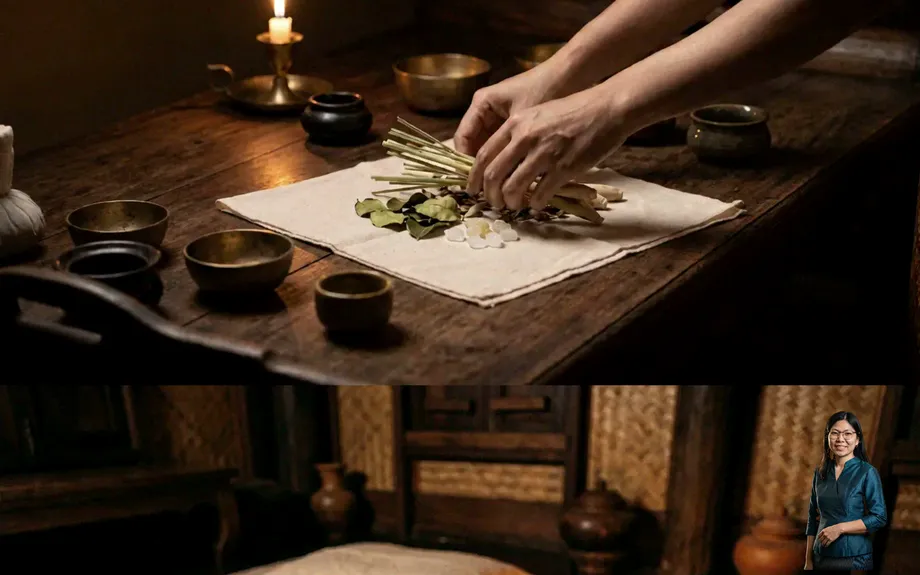
The host
A host stands in the bottom corner. She speaks up with a single sentence — "Good to see you. If you like, I'll show you the house first." — and offers exactly one next step alongside it. Beside that sits a close button that takes the prompt away and does not bring it back.
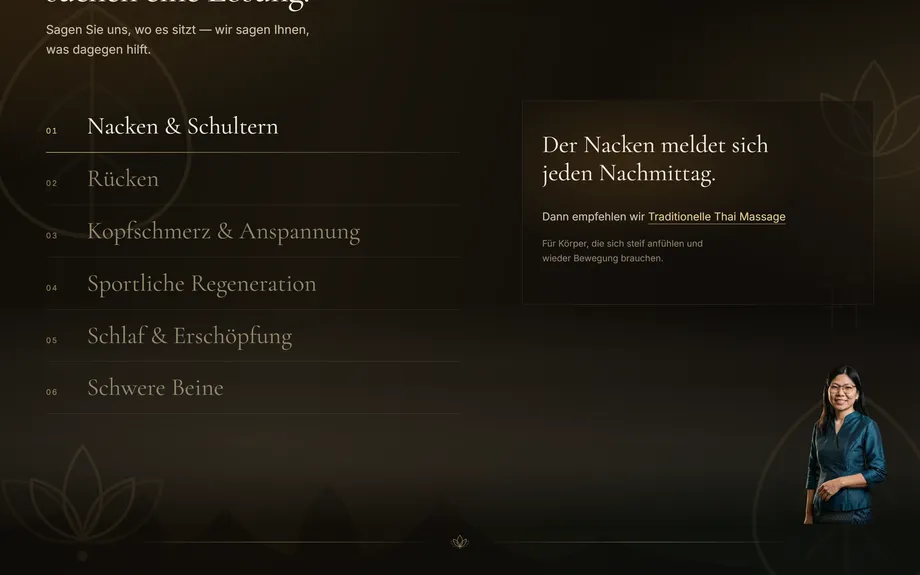
Address her and you get no input field but a set of choices: "Reserve a time" as the first and largest option, then treatments, prices and packages, gift a voucher, see the house, and contact and directions — with the direct line by email or phone kept separate below.
That there is no free-text field is the real decision. A chat window promises a conversation and delivers canned phrases; it also requires that what visitors type be processed somewhere. This host accepts nothing, sends nothing and needs no outside service — which is what makes the measured zero third-party hosts possible in the first place.
She is operable by keyboard, announces as a button that she opens a dialog, and reports her state. For a studio that makes her what a person at reception does: ask where someone wants to go and show them the way — rather than a window that pushes itself forward uninvited.
- Speaks up with one sentence and exactly one next step
- Choices instead of an input field — no chat window, no canned phrases
- "Reserve a time" is the first and largest option
- Accepts nothing and sends nothing — no outside service involved
- Keyboard operable, announcing its dialog and reporting its state
- The prompt can be dismissed and does not come back
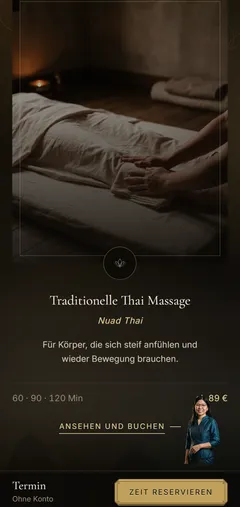
The booking flow
Booking is the heart of this demo, and it is built towards a single number: four steps. Which treatment, when it suits you, who should treat you, how to reach you. No account, no registration, no password — the page promises "in under a minute" and the flow keeps to it.
The order is deliberate. The treatment comes first, with its price and duration tiers, because that is the decision a guest actually makes. Only at the end, once the decision stands, does the site ask for contact details — rather than as a ticket to enter.
Choosing the therapist is a step of its own rather than a side field. In a studio where guests come back, that is the detail that decides the second booking.
Because the studio does not exist, no appointment is created either. That sits as a box within the flow, with the technically accurate reason: entries stay in the browser, nothing is sent and nothing is stored. For a demo that touches on health data, that is the only defensible way to build it.
- Four steps: treatment, time, therapist, contact
- No account, no registration, no password
- Price and duration tiers come before the contact details, not after
- Choosing a therapist is a step of its own, not a side field
- Entries stay in the browser — nothing is sent and nothing is stored
- The demo character is stated inside the flow, not only in the imprint
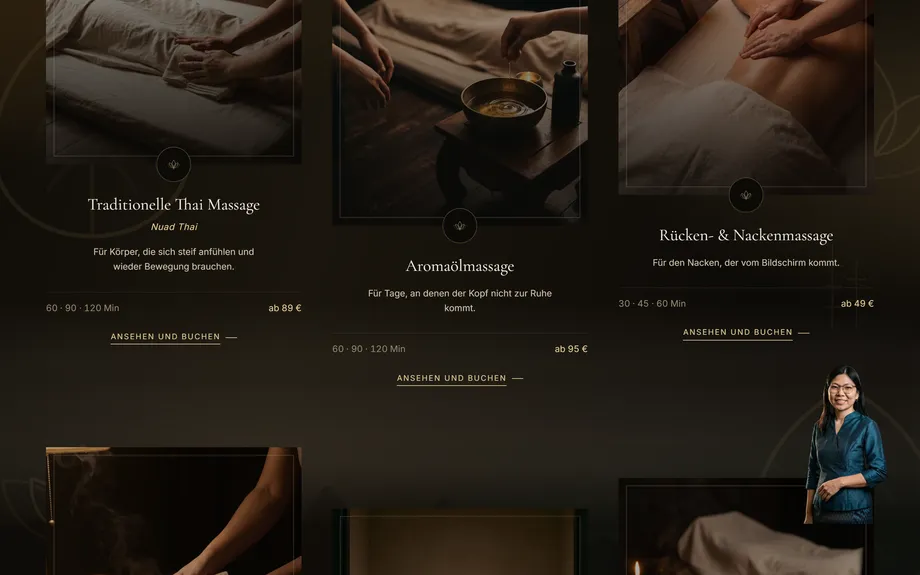
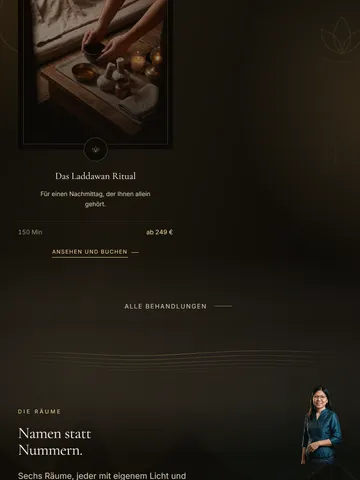
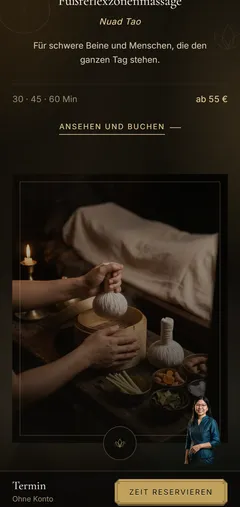
Architecture, speed & data thrift
Beneath the surface sits a split that is the real value of this demo: some components belong to the platform — scroll film, assistant, consent management, image component — and others to the tenant: hero, treatment grid, booking bar, footer. The film on this page is the same component as on its sister projects, only with different images and different words.
For a real engagement that means a second studio does not get a copy of this site but the same substructure with its own brand, its own treatments and its own prices. What stands here as a demo is the template, not the stencil.
The site loads nothing from third parties. Measured, that is 71 requests to exactly one host, its own domain: no analytics, no maps, no external fonts. The largest paint arrives in 0.6 seconds, and accessibility and SEO both measure 100.
One point is open and is not being talked around here: the home page shifts content while loading, a measured CLS of 0.131 — reproducible across several runs and therefore above what Google treats as good. On a page carrying a frame-sequence film that is fixable, but it has not been fixed.
- Shared platform components alongside tenant-owned ones
- The same film component as its sister projects, different images and words
- 0 third-party hosts across 71 requests
- 0.6 s to the largest paint; accessibility and SEO both 100
- Open item: CLS 0.131 on the home page — reproducible, not yet fixed
What a real studio takes from it
A studio taking on this site swaps brand, treatments, prices, rooms and therapists — and keeps everything else: the booking flow, the film as a component, the treatment pages with their pricing logic, the voucher flow, and the structure that leads from a treatment to a decision.
What is deliberately not included are invented reviews, invented occupancy figures or an invented history of the house. A real business has to contribute those, and whether the site carries depends on exactly that.
For day-to-day operation the deciding question is not the look but where the appointment lands. This demo deliberately stops short of that line: the flow is built, while connecting it to a calendar or a point-of-sale system belongs to a real project rather than to a demonstration.
- Booking flow, treatment pages and vouchers stay; the content changes
- Prices, duration tiers and rooms as data rather than text inside templates
- No invented reviews or occupancy figures in the delivery
- Connecting a calendar or point-of-sale system belongs to a real project
- Transferable to studios, practices and any business selling time rather than goods
Technology Stack
- Framework
- Angular
- Rendering
- Static Site Generation (prerendering)
- Architecture
- Shared platform components + tenant components
- Motion
- Scroll-linked frame sequence on canvas
- Booking
- Four steps, no account, entirely in the browser
- Privacy
- Consent management of its own
- Image production
- AI-generated, no real people
- Third-party services
- None
Take bookings directly instead of through a portal?
This demo shows how a studio explains its treatments, states its prices and takes the appointment itself — no commission, no portal profile, and no account for the guest to create.